1C vs 3C vs 5C Charging Rates: What Do C-Ratings Mean for Li-ion Batteries?
Learn what 1C, 3C, and 5C charging rates mean, how battery C-rates are calculated, and how fast charging impacts battery performance, safety, and lifespan. A practical guide for lithium battery applications and custom battery pack design.
What Is a Battery Charging C-Rate?
A battery C-rate indicates how quickly a battery is charged or discharged relative to its rated capacity.
The formula is:
C Rate= Charging Current ⁄ Battery Capacity
For example:
| Battery Capacity | Charging Current | C-Rate |
|---|---|---|
| 2000mAh | 2A | 1C |
| 2000mAh | 6A | 3C |
| 2000mAh | 10A | 5C |
A higher C-rate means faster charging but also places greater stress on the battery.
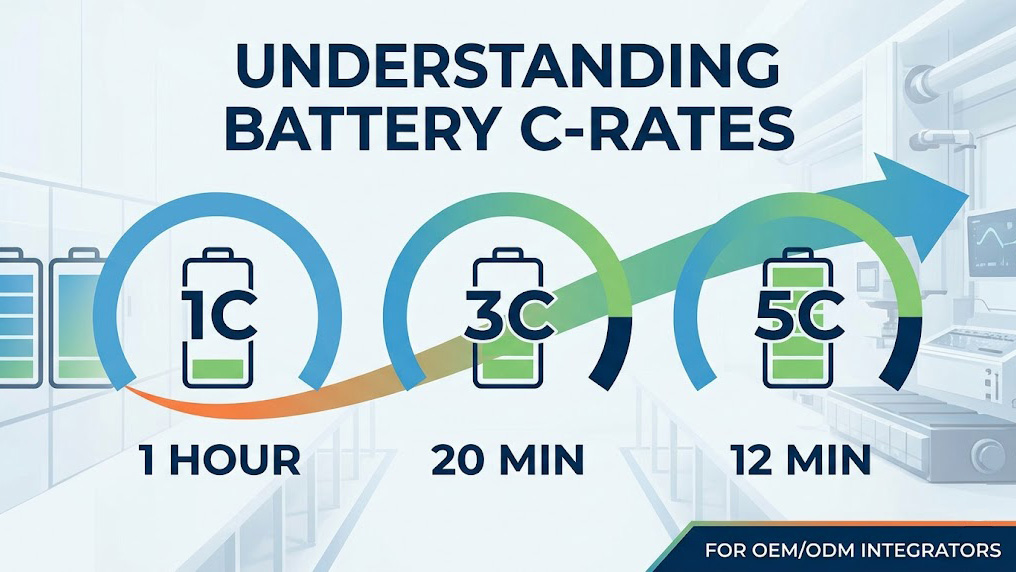
Quick Comparison: 1C vs 3C vs 5C Charging
| Charging Rate | Full Charge Time* | Battery Stress | Typical Applications |
|---|---|---|---|
| 1C | ~60 min | Low | Smartphones, consumer electronics |
| 3C | ~20 min | Medium | Fast-charging devices, portable power stations |
| 5C | ~12 min | High | EV fast charging, drones, industrial equipment |
*Actual charging time varies depending on charging profiles and battery management systems (BMS).
What Is 1C Charging?
1C charging means the charging current equals the battery’s rated capacity.
Example:
- 2000mAh battery → 2A charging current
- 50Ah battery → 50A charging current
Advantages
- Lowest heat generation
- Longest battery lifespan
- High charging efficiency
- Better long-term reliability
Typical Applications
- Consumer electronics
- Medical equipment
- Backup power systems
What Is 3C Charging?
3C charging delivers a current three times the battery capacity.
Example:
- 2000mAh battery → 6A
- 50Ah battery → 150A
Advantages
- Faster charging
- Balanced performance and longevity
- Widely adopted in modern electronics
Common Applications
- Fast-charging smartphones
- Portable power stations
- E-bikes
- Energy storage systems
What Is 5C Charging?
5C charging is considered ultra-fast charging.
Example:
- 2000mAh battery → 10A
- 50Ah battery → 250A
Benefits
- Extremely short charging times
- Reduced downtime
- Improved operational efficiency
Challenges
- Increased heat generation
- Higher material requirements
- More complex battery management systems
- Faster long-term battery degradation
Can All Lithium Batteries Support 5C Charging?
No.
Only specially designed high-rate lithium batteries can safely support 5C charging.
These batteries often require:
- Advanced electrode materials
- Optimized cell design
- High-performance electrolytes
- Intelligent Battery Management Systems (BMS)
- Enhanced thermal management solutions
Attempting to charge a standard lithium battery at 5C may cause overheating, swelling, reduced cycle life, or safety risks.
How Does Charging Rate Affect Battery Life?
Generally:
| Charging Rate | Expected Impact on Cycle Life |
|---|---|
| 1C | Minimal impact |
| 3C | Moderate impact |
| 5C | Significant impact if used frequently |
Selecting the optimal charging rate depends on balancing charging speed, safety, and battery longevity.
Applications of Different C-Rates Across Industries
Consumer Electronics
Typically 1C–3C charging for smartphones, tablets, and wearables.
Medical Devices
Generally 0.5C–1C to maximize reliability and lifespan.
Drones and Robotics
Often require 3C–5C charging for rapid deployment.
Electric Vehicles
Modern EV batteries increasingly support 3C–5C fast charging technologies.
Industrial Equipment
Customized battery packs may use high-rate charging solutions to minimize operational downtime.
FAQ
What does 1C mean in a battery?
1C means the charging or discharging current equals the battery’s rated capacity, allowing a theoretical full charge in one hour.
Is 5C charging safe?
Yes, but only for batteries specifically designed for high-rate charging and equipped with proper thermal management and BMS protection.
Does fast charging damage lithium batteries?
Higher charging rates generate more heat and stress, which can accelerate aging over time. However, modern batteries and BMS designs significantly reduce these effects.
Which charging rate is best?
- 1C for maximum lifespan
- 3C for balanced performance
- 5C for ultra-fast charging applications