
What Is a Battery Management System (BMS)?

As rechargeable battery technology continues to evolve, Battery Management Systems (BMS) have become an essential part of modern battery solutions. From consumer electronics and medical devices to industrial equipment and IoT applications, a BMS plays a critical role in ensuring battery safety, stability, and long-term performance.
For lithium battery packs, a BMS is more than just a protection board — it is the intelligent control system that monitors and manages battery operation.
What Is a Battery Management System?
A Battery Management System (BMS) is an electronic control system designed to monitor, protect, and manage rechargeable battery packs.
The primary purpose of a BMS is to ensure that the battery operates within safe working conditions while maintaining reliable performance and extending battery lifespan.
A BMS continuously monitors key battery parameters such as:
- Voltage
- Current
- Temperature
- Charging status
- Discharging status
- Cell balance condition
When abnormal conditions are detected, the BMS can automatically activate protection mechanisms to help prevent battery damage or safety risks.
Why Is a BMS Important?
Lithium batteries are highly efficient energy storage devices, but they are sensitive to improper operating conditions.
Issues such as:
- Overcharging
- Overdischarging
- Excessive current
- Overheating
- Cell inconsistency
may negatively affect battery performance, lifespan, and safety.
A BMS helps minimize these risks through real-time monitoring and intelligent protection.
Key Benefits of a BMS
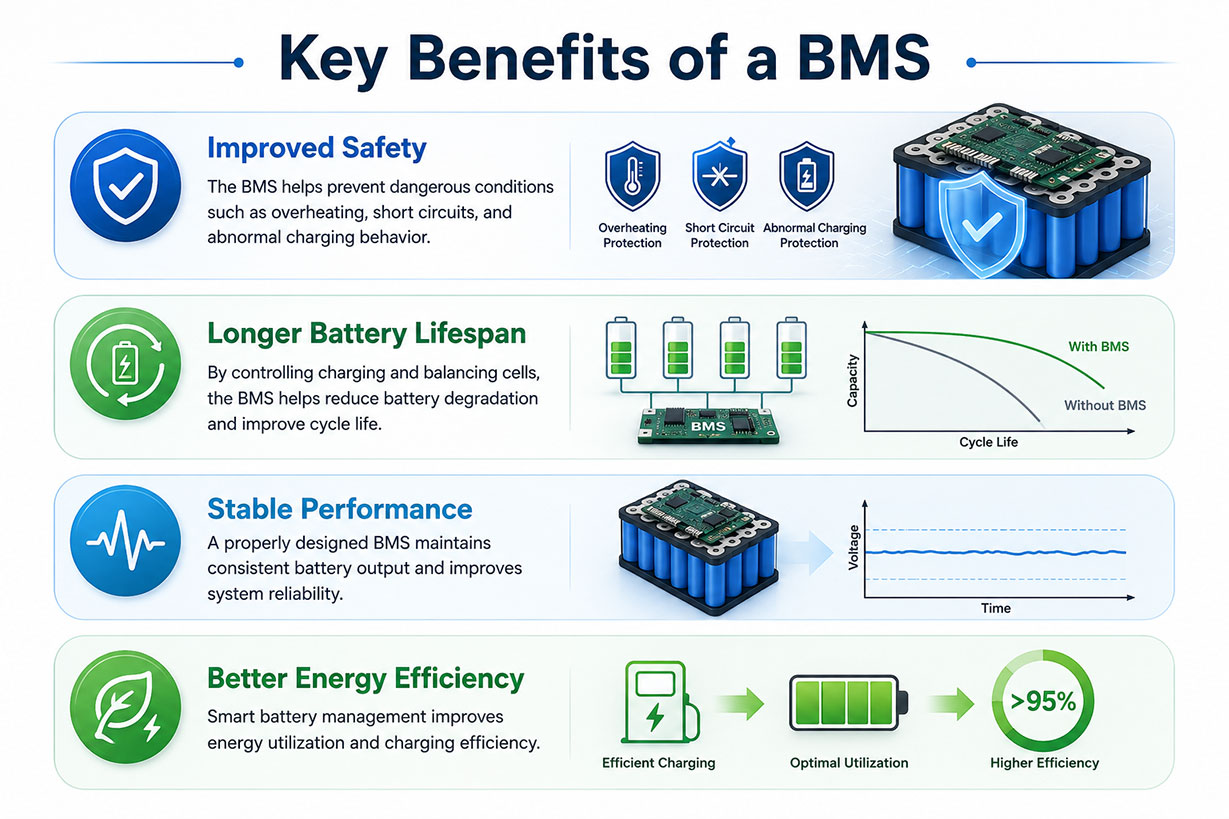
Improved Safety
The BMS helps prevent dangerous conditions such as overheating, short circuits, and abnormal charging behavior.
Longer Battery Lifespan
By controlling charging and balancing cells, the BMS helps reduce battery degradation and improve cycle life.
Stable Performance
A properly designed BMS maintains consistent battery output and improves system reliability.
Better Energy Efficiency
Smart battery management improves energy utilization and charging efficiency.
Applications of BMS
Battery Management Systems are widely used in:
- Consumer electronics
- Medical devices
- Industrial equipment
- Portable power systems
- IoT devices
- Robotics
- Energy storage systems
As battery-powered devices become more advanced, intelligent BMS technology is becoming increasingly important.
Conclusion
A Battery Management System is one of the most critical components in modern rechargeable battery packs. By monitoring battery conditions and providing multiple layers of protection, a BMS helps improve safety, reliability, and battery lifespan.
Understanding the role of BMS technology is essential for developing safe and efficient battery-powered products.