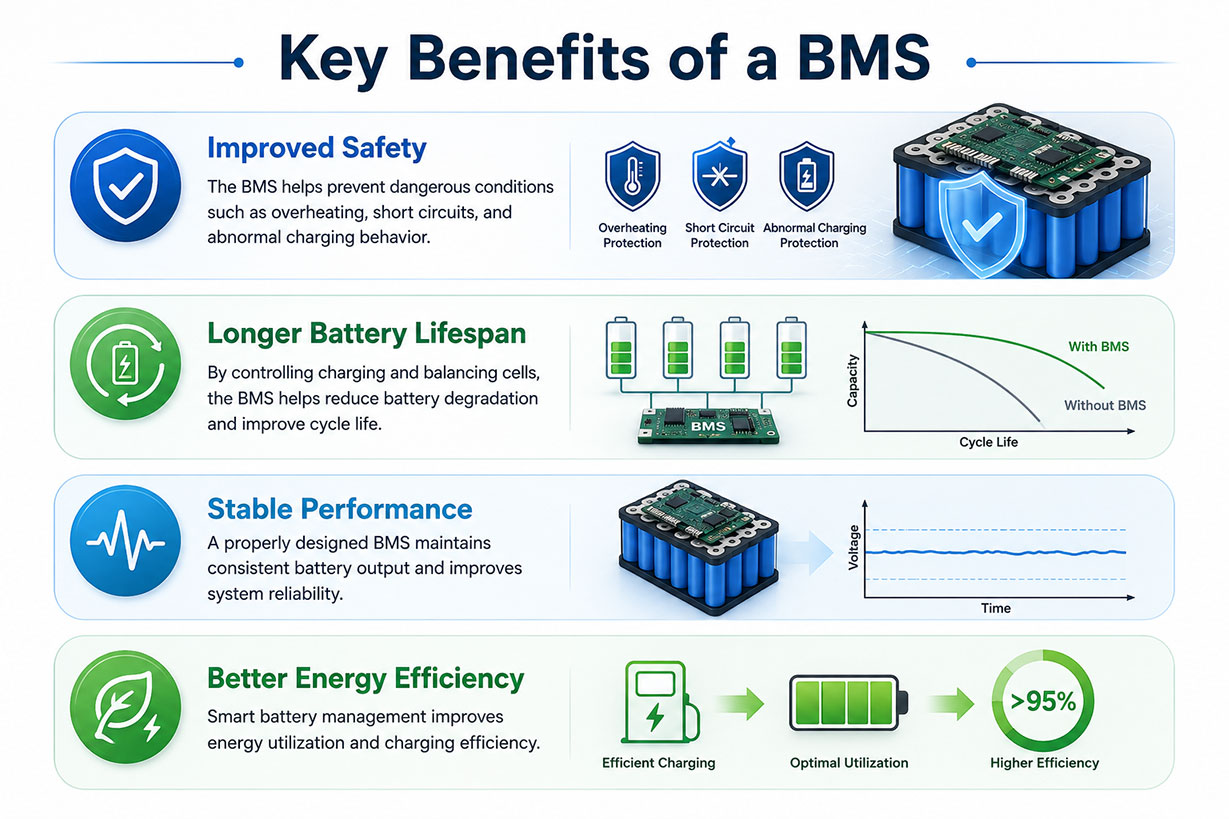
A modern Battery Management System (BMS) performs far more than basic battery protection. In today’s rechargeable battery systems, smart BMS technology continuously monitors battery conditions, manages charging and discharging behavior, and helps improve battery safety, efficiency, and lifespan.
For lithium battery packs used in consumer electronics, medical devices, industrial equipment, and IoT products, a reliable Battery Management System is essential for stable and safe operation.
Overcharge Protection Function
Overcharging is one of the most common causes of lithium battery damage.
When battery voltage exceeds safe charging limits, excessive heat generation may occur, increasing the risk of battery swelling, capacity degradation, or thermal failure.
A smart BMS continuously monitors charging voltage and automatically disconnects charging when abnormal voltage levels are detected.
This protection function helps improve lithium battery safety and long-term reliability.
Overdischarge Protection Function
Excessive discharge may permanently damage lithium battery cells and reduce battery cycle life.
The Battery Management System prevents battery voltage from dropping below the minimum safe operating range.
By controlling discharge conditions, the BMS helps maintain stable battery performance and protects battery health.
Overcurrent Protection Function
High current flow during charging or discharging may damage battery cells and electronic components.
A BMS monitors current conditions in real time. When excessive current is detected, the system automatically disconnects the circuit to protect the battery pack.
Overcurrent protection is especially important in high-power battery applications.
Short Circuit Protection Function
Short circuits may cause rapid temperature increase, battery failure, or safety hazards.
The Battery Management System quickly detects abnormal current flow and cuts off the electrical path to help protect both the battery and connected devices.
Fast response speed is critical for lithium battery safety protection.
Temperature Monitoring and Thermal Protection
Temperature management is one of the most important functions of a smart Battery Management System.
Lithium batteries are highly sensitive to operating temperatures. Excessive heat or extremely low temperatures may negatively affect battery performance and lifespan.
A BMS uses temperature sensors to continuously monitor thermal conditions during charging and discharging.
When abnormal temperatures are detected, the system automatically activates thermal protection mechanisms.
Cell Balancing Function
In multi-cell lithium battery packs, slight differences between cells may gradually increase during operation.
Without proper balancing, inconsistent cell voltage may reduce usable capacity and accelerate battery degradation.
Cell balancing helps maintain voltage consistency between battery cells, improving:
- Battery stability
- Energy efficiency
- Capacity utilization
- Battery lifespan
- Overall pack reliability
Cell balancing is a critical feature in smart Battery Management Systems.
Battery Monitoring and Data Collection
Modern Battery Management Systems continuously collect and analyze battery operating data.
Common monitoring parameters include:
- Battery voltage
- Current
- Temperature
- Remaining capacity
- State of Charge (SOC)
- State of Health (SOH)
Accurate battery monitoring helps optimize battery operation and improve system reliability.
Communication Functions in Smart BMS
Many intelligent Battery Management Systems support communication interfaces such as:
- CAN Bus
- SMBus
- UART
- RS485
- Bluetooth
These communication protocols allow external devices and control systems to access battery information in real time.
Communication-enabled BMS solutions are widely used in industrial equipment, smart electronics, IoT systems, and medical battery applications.
Fault Detection and Safety Protection
Advanced Battery Management Systems can identify abnormal battery conditions and provide fault warnings.
Common fault detection functions include:
- Overvoltage detection
- Undervoltage detection
- Overtemperature warning
- Communication failure detection
- Cell imbalance warning
These protection mechanisms help improve battery system safety and operational reliability.
Conclusion
A modern Battery Management System integrates multiple monitoring, protection, balancing, and communication functions to ensure safe and efficient battery operation.
From overcharge protection and thermal management to intelligent communication and fault detection, BMS technology is essential for modern lithium battery systems.
As battery applications continue to expand across multiple industries, smart Battery Management Systems will remain a key technology for safe, reliable, and high-performance energy solutions.