
UL 2271 vs UL 2849: Component vs. System-Level E-Bike Safety Standards Explained
What is UL 2271?
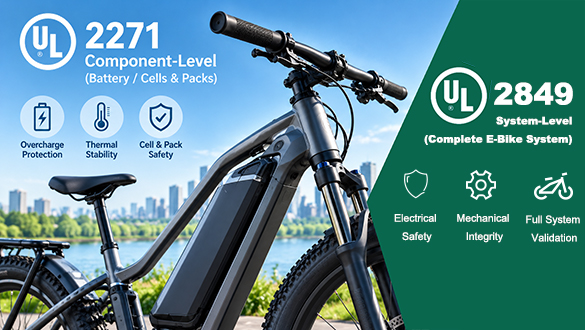
The Battery-Level Safety Standard UL 2271 (Standard for Batteries for Use In Light Electric Vehicle Applications) specifically focuses on the physical, environmental, and electrical integrity of rechargeable battery packs used in light electric vehicles (LEVs), including e-bikes, e-scooters, and hoverboards.
Key Safety Evaluations Under UL 2271:
- Mechanical & Structural Integrity: Evaluates pack enclosure resistance against heavy vibration, shock drops, crushing, penetration, heat, UV exposure, and flame propagation.
- Electrical Protection: BMS-controlled protection against overcharging, over-discharging, external short-circuiting, and cell thermal runaway.
- Environmental Limits: Thermal shock, rapid temperature cycling, and water ingress tests.
Core Value: UL 2271 answers: “Is this battery pack intrinsically safe during handling, charging, or standalone storage?”
What is UL 2849?
The Comprehensive E-Bike System Standard UL 2849 (Standard for Electrical Systems for eBikes) provides a holistic safety evaluation of the entire drive train and power network on an electric bike.
Key System Aspects Evaluated Under UL 2849:
- System Component Integration: Verifies safe interaction between the battery, motor, drive controller, display unit, sensors, and charger.
- Fire & Electrical Shock Mitigation: Tests insulation, line voltage limits, harness shorting, and overload protection across the entire power loop.
- Charger Interoperability: Prevents thermal runaway caused by voltage mismatch, improper handshake protocol, or third-party charger risks.
Core Value: UL 2849 answers: “Is the entire e-bike electrical ecosystem safe when all components operate together under load?”
Direct Comparison: UL 2271 vs. UL 2849
The following comparison matrix breaks down the technical differences between battery component certification and full e-bike system certification:
| Technical Aspect | UL 2271 | UL 2849 |
| Certification Level | Component Level (Battery Pack) | System Level (Whole Vehicle) |
| Evaluation Scope | Cells, BMS, wiring, battery enclosure | Battery, motor, controller, charger, display, wiring |
| Primary Risk Prevention | Battery thermal runaway, short circuit, casing rupture | System electrical fires, shock hazards, component mismatches |
| Testing Methodology | Crush, vibration, drop, thermal cycling, overcharge | UL 2271 battery validation + interoperability, wiring harness load |
| Primary Target Audience | Battery OEMs, replacement pack sellers | E-bike brands, OEMs, retail chains, importers |
| Regulatory Standing | Mandatory for standalone batteries (e.g., NYC Law) | Mandated for complete e-bike sales in strict markets |
Regulatory Impact and Market Compliance Guidelines
Due to rising global concern over lithium-ion battery fires, regulatory bodies and online marketplaces strictly enforce these standards:
- Municipal Mandates (e.g., New York City): NYC Local Law requires all e-bikes sold or rented to be certified to UL 2849, and all standalone/replacement batteries to be certified to UL 2271.
- Retail & Marketplace Policy: Major platforms (Amazon, Target, Walmart) demand certified proof from a Nationally Recognized Testing Laboratory (NRTL) to prevent product delisting.
- CPSC Requirements: The U.S. Consumer Product Safety Commission strongly urges manufacturers to comply with UL 2849 to mitigate fire hazards and avoid mandatory recalls.
How Custom Battery Manufacturers Ensure Compliance
Hypercell optimize design from the ground up to ensure seamless compliance with both standards:
- Hardware-Level BMS Protections: Multi-stage protection against overcurrent, cell imbalance, overvoltage, and extreme temperatures.
- Advanced Enclosure Architecture: Flame-retardant structural materials (UL 94-V0) and waterproof seals (IPX6/IPX7) for rugged durability.
- Smart Communication Integration: Protocols like CANbus, UART, and Bluetooth allow smart BMS diagnostics and smooth communication with UL 2849 drive controllers.
Case Study: Engineering the IFR14500-15S4P Pack for Scooters & E-Skateboards
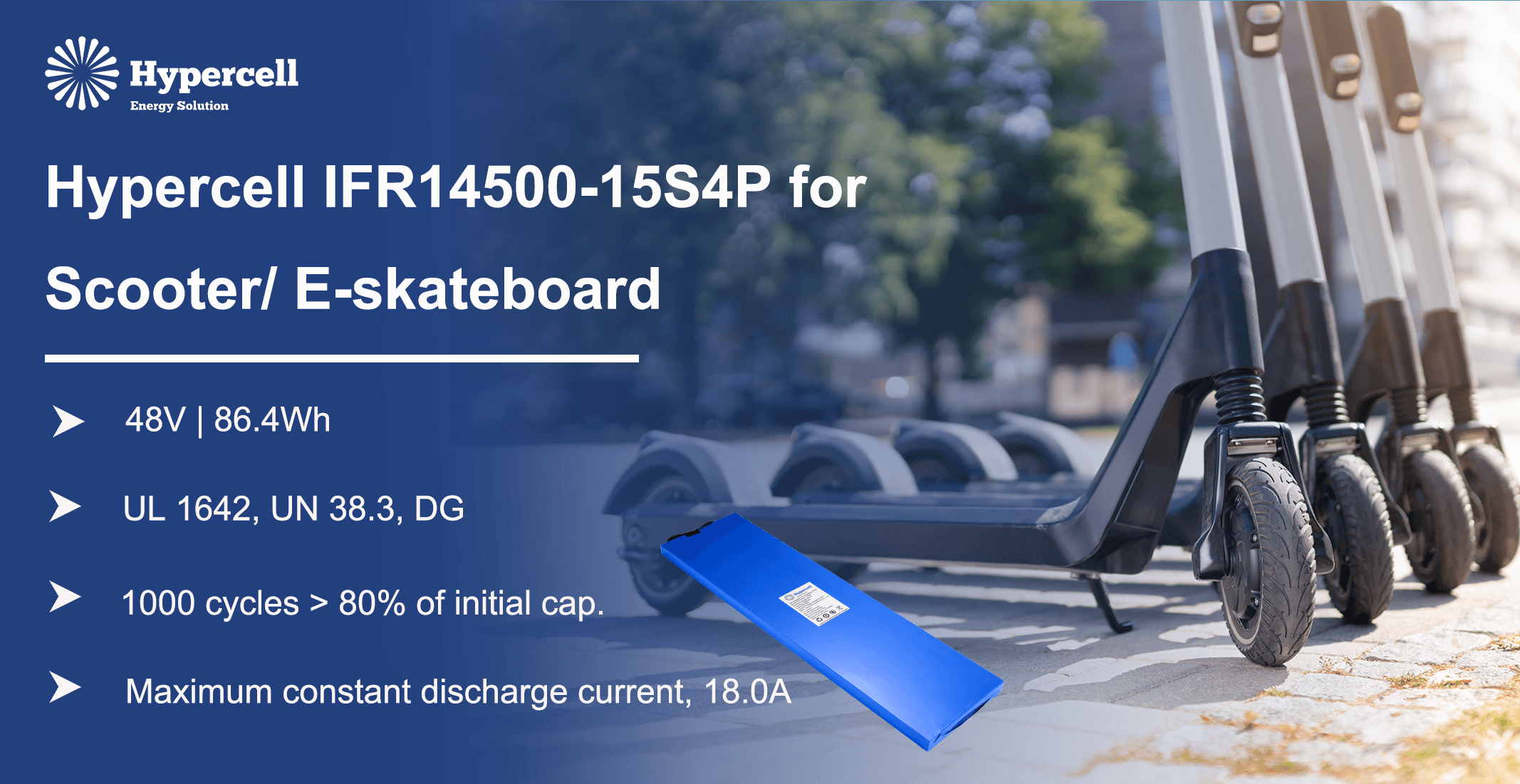
Take the Hypercell IFR14500-15S4P battery pack as an engineering example:
- Chemistry & Configuration: Built with Lithium Iron Phosphate (LiFePO4) chemistry in a 15-series, 4-parallel (15S4P) arrangement. It delivers a nominal system voltage of 48V (54.75V peak), offering high voltage stability for light electric powertrains.
- Safety & Thermal Advantages: LiFePO4 chemistry inherently possesses superior thermal stability and resistance to thermal runaway compared to standard NMC cells. This high intrinsic safety margin simplifies meeting UL 2271 cell- and pack-level thermal abuse testing.
- Vibration & Structural Engineering: Scooters and e-skateboards experience intense road vibration. Incorporating 60 cylindrical 14500 cells requires specialized cell holders, heavy-duty nickel busbars, and robust potting/enclosure insulation to prevent internal short circuits under shock—a primary focus during UL 2271 physical drop and vibration evaluations.
- System Interoperability: To support UL 2849 full-system integration, the battery can be paired with a custom Smart BMS featuring CAN/UART bus protocols. This enables real-time voltage, current, and temperature handshakes between the pack, motor controller, and charger, guaranteeing system-level electrical protection.
Design Tip for OEM Buyers: While the IFR14500-15S4P design offers ultra-high chemistry safety, its compact cell size (14500 format) means capacity is optimized for ultra-portable, light-duty mobility. For higher-power or long-range e-bikes, engineering teams often evaluate higher-capacity form factors to balance energy density and system efficiency under UL standards.
Frequently Asked Questions (FAQ)
Q1: Is UL 2271 required for UL 2849 certification?
A: Yes. Under standard UL 2849 system evaluation, the battery pack integrated into the e-bike typically must be certified to UL 2271 or meet equivalent battery safety criteria.
Q2: Can an e-bike be legally sold if it only has UL 2271 certification?
A: In regulated markets like NYC, no. Selling a full e-bike requires system-level UL 2849 compliance, whereas UL 2271 only covers replacement or standalone batteries.
Q3: What is a Nationally Recognized Testing Laboratory (NRTL)?
A: An NRTL is an OSHA-approved independent laboratory (such as UL Solutions, TÜV Rheinland, SGS, or Intertek) authorized to test and certify products against ANSI/UL safety standards.