
Discover Hypercell’s INR18650 wide-temperature Li-ion cells (-40°C to 85°C). Featuring up to 70% retention at -40°C, full MES traceability, multi-country certifications (UL1642, CB, KC, PSE), and custom OEM battery pack solutions.

Extreme Climate Challenges in Next-Gen Industrial Power

Standard lithium-ion batteries suffer severe failure in extreme outdoor or industrial environments. At -20°C and below, common liquid electrolytes freeze, leading to spiked internal resistance and drastic voltage drops. Conversely, continuous operation or storage at temperatures above 60°C accelerates internal side reactions, capacity fade, and severe thermal hazards.

For mission-critical applications—ranging from arctic monitoring stations and maritime telemetry to aerospace devices—power supply failure is not an option.

To resolve these environmental and reliability bottlenecks, Hypercell offers its specialized INR18650 Wide-Temperature Cell Series, combining extreme temperature performance with Full-Process MES (Manufacturing Execution System) Quality Traceability for global OEM/ODM brand partners.

Proven Low & High-Temperature Performance

Engineered with low-impedance electrode architectures and modified electrolyte formulations, Hypercell’s wide-temperature INR18650 cells retain exceptionally high energy output across severe thermal swings.

Key Thermal & Electrical Capabilities:
Extended Voltage Range: 2.00V ~ 4.20V (Maximizing energy extraction in low-temp environments)
Extreme Discharge Range: -40°C to 85°C
Extreme Charging Range: -20°C to 60°C
Discharge Capacity: Retains up to 60% – 70% of initial capacity (at 0.2C)
Storage Stability: Retains >85% – 90% capacity retention after 1,000 hours of high-temp aging
Long Cycle Life: >70% initial capacity after 500 cycles (0.3C charge/discharge)

INR18650 Wide-Temperature Model Matrix
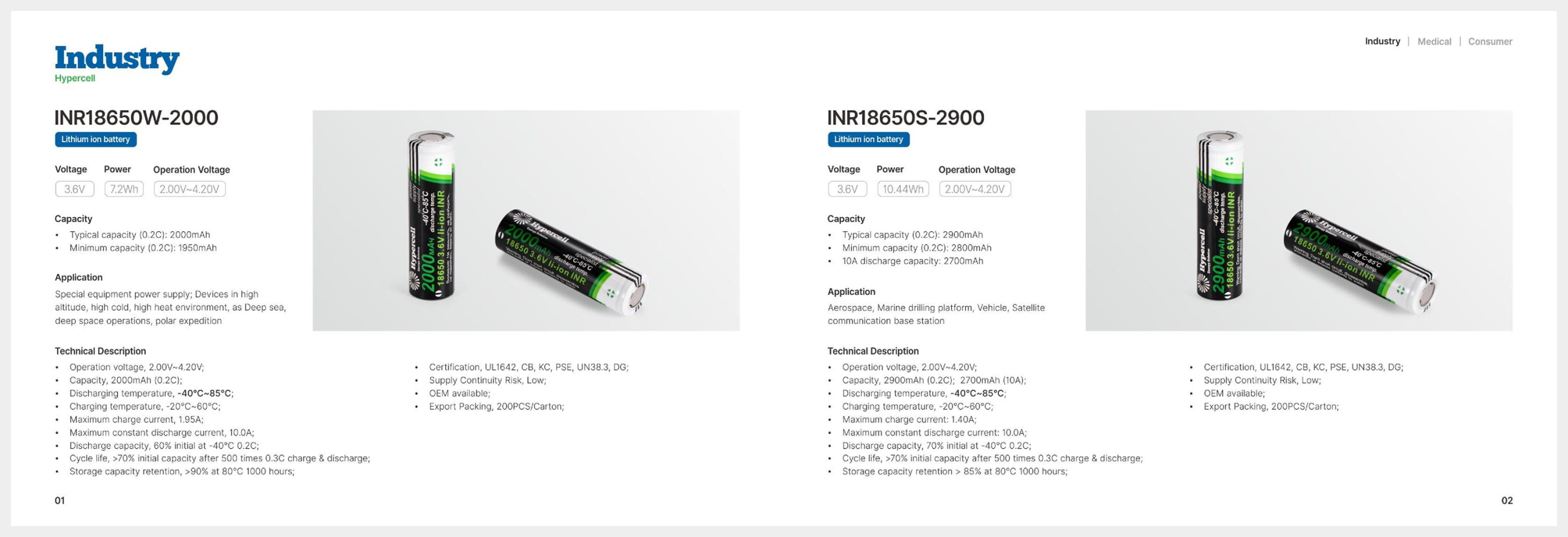
Hypercell INR18650 wide temperature catalogue

ModelTypical Capacity(mAh)Nominal Voltage(V)Max.Charge Voltage(V)Max.Charge Current(C Rate)Max.Cont.
Discharge(C Rate)
Internal
Resistance(mΩ)
Cycle
Life
INR18650T20003.64.21.0C5.0C≤40≥500
INR18650S29003.64.21.0C3.0C≤28≥500
INR18650-34LP33503.64.20.5C2.0C≤45≥500

High-Reliability Deployment Scenarios

Hypercell INR18650 wide-temperature solutions cater to ultra-demanding industrial, medical, and consumer electronics applications:

1. Aerospace & Space Operations: Satellite communication base stations and high-altitude devices operating under extreme thermal fluctuations.
2. Marine & Extreme Off-Shore: Marine drilling platforms, maritime signal systems, and deep-sea exploration tools.
3. Polar Expeditions & Extreme Climate Monitoring: Arctic meteorological nodes, outdoor telemetry, and high-altitude environmental sensors.
4. Special Industrial & Field Medical Supplies: Ruggedized vehicle tracking, smart grid inspection gear, and portable rescue devices.

End-to-End MES Traceability & Global Certification

For B2B brand owners, battery safety and lot consistency are critical purchasing criteria. Hypercell enforces stringent quality management backed by global certification and digital transparency:

Full-Process MES Tracking: Every cell is QR/Barcode serialized. From raw material inspection and automated IR/capacity matching to BMS welding and final End-of-Line (EOL) testing, 100% of manufacturing parameters are logged and permanently traceable.

Global Compliance Ready: Fully certified with UL1642, CB, KC, PSE, UN38.3, and DG (Dangerous Goods) compliance, facilitating smooth global shipment and market clearance for our OEM partners.
Supply Chain Continuity: Low supply continuity risk with standard export packing (200 PCS/Carton) and flexible OEM pack assembly.

Tailored OEM/ODM Custom Battery Pack Engineering

Beyond supplying standard cells, Hypercell acts as an end-to-end battery engineering partner:

Custom Wide-Temp BMS: Specialized protection boards with dynamic low-temp charging protection, high-temp cutoff, and accurate SOC algorithms.
Rugged Mechanical Designs: IP67/IP68 waterproof casings, anti-vibration structures, and thermal insulation tailored for severe operating conditions.

Partner with Hypercell

Looking for reliable wide-temperature lithium batteries backed by transparent manufacturing and international compliance? Contact our engineering team today to request testing samples or discuss custom battery pack design.
 

The European Commission has officially issued the Guidance Document: Digital Batteries Passport – data points by category (Ver. 1.0), marking a critical milestone for the EU Battery Regulation ((EU) 2023/1542). Outline 71 meticulous data points, this guidance establishes the technical blueprint for the mandatory Digital Battery Passport (DPP) effective February 18, 2027. As a specialized OEM/ODM manufacturer of custom Light Means of Transport (LMT) battery packs (e.g., e-scooters, e-bikes), Hypercell has successfully upgraded its factory MES (Manufacturing Execution System) and ERP infrastructure. Combined with its proprietary smart BMS dynamic data architecture, Hypercell provides global B2B clients with fully compliant custom battery solutions tailored for seamless market entry into Europe.

1. Key Takeaways of the EU Guidance for LMT Batteries

Under the latest European guidance, LMT batteries installed in e-scooters and e-bikes are prioritized for mandatory DPP implementation. Unlike standard industrial batteries, LMT batteries demand both “static supply chain traceability” and “dynamic operational monitoring”:

Data CategoryEU Guidance RequirementHypercell Compliance Capability
Basic Identification & TraceabilityUnique Identifier (UID) & ISO/IEC 15459 QR code, recording manufacturing date, GPS coordinates, and battery chemistryMES Automated Binding: Scanned QR tracking on the production line automatically syncs UID with MES logs
Critical Raw & Recycled MaterialsMandatory disclosure of recycled cobalt, lithium, and nickel ratios, plus raw material sourcingERP/SRM Closed-Loop Tracking: Upstream supplier coordination using Mass Balance accounting for recycled content
Dynamic Performance & Health (SOH)Real-time or periodic telemetry on capacity fade, internal resistance, cycle counts, and extreme conditionsIn-House Smart BMS: Advanced telemetry capabilities reading and outputting live SOH metrics via standardized API interfaces
Safety & Dismantling GuidelinesDetailed dismantling exploded diagrams, required tools, hazardous substances list (RoHS/REACH), and extinguishing agentsStandardized R&D Documentation: Comprehensive SDS manuals and English dismantling guides generated during the ODM phase

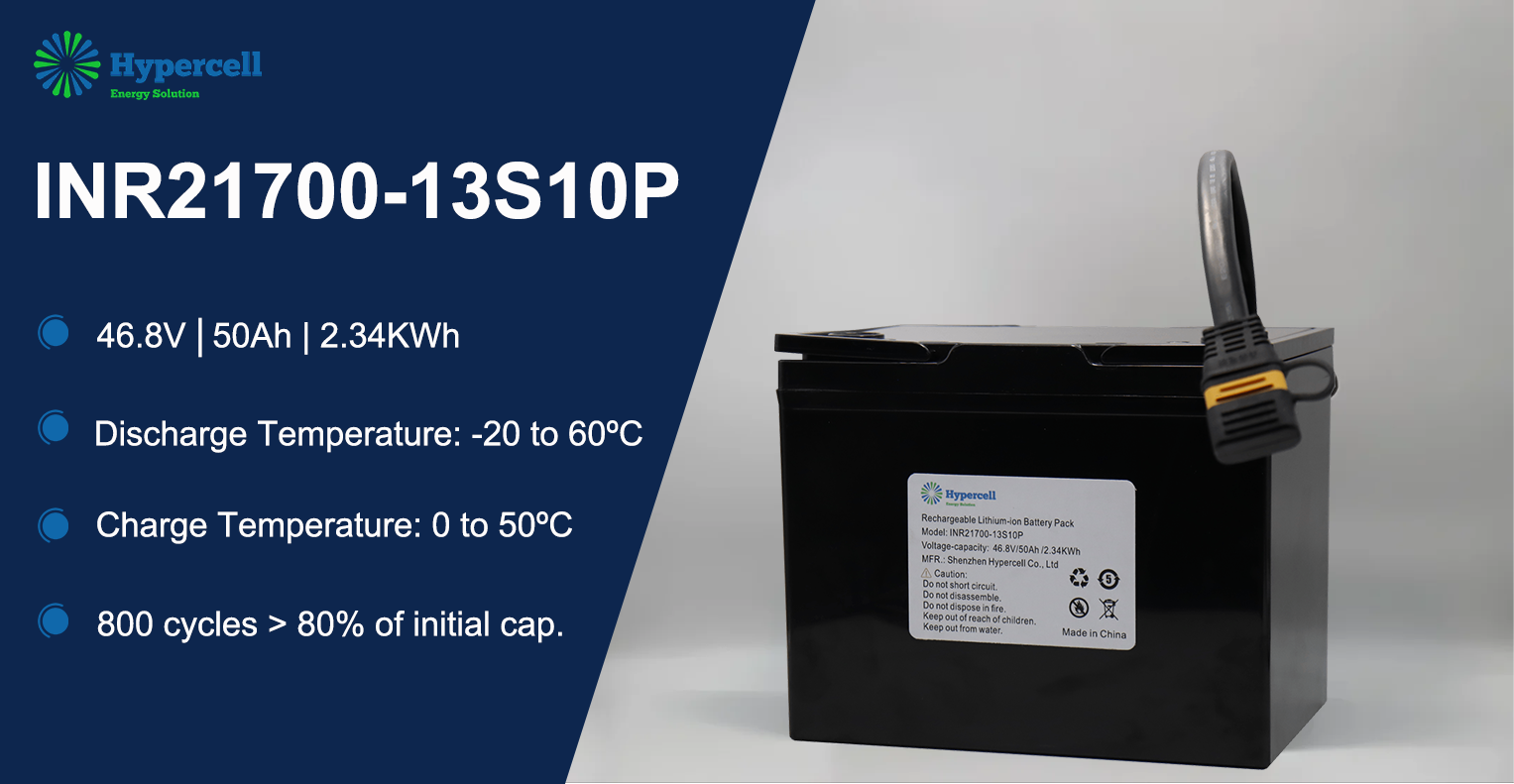
2. Case Study: Compliance in Action for the INR21700-13S10P Custom LMT Pack

ypercell INR21700-12S10P custom LMT battery pack with QR code for EU Battery Passport compliance

Highlighting Hypercell’s engineering excellence, the high-demand INR21700-13S10P custom battery pack (48V / 50Ah class), designed for European premium e-bikes and e-scooters, exemplifies complete DPP readiness across its lifecycle:

Factory-Level Digital ID (UID Integration):Including Hypercell’s manufacturing site location (GPS), battery weight, nominal energy (kWh), and official CE / UN38.3 certification records.
Proprietary BMS Telemetry for Dynamic Health:Equipped with Hypercell’s in-house developed BMS, the pack measures internal resistance (mΩ), cumulative throughput energy, and cycle counts during operation. Via CANbus/UART or integrated IoT modules, the BMS transmits real-time State of Health (SOH) updates to the DPP database—solving the primary compliance challenge for LMT brands.
Green Manufacturing & LCA Footprint Readiness:Leveraging ERP energy-monitoring modules, Hypercell provides a verified Cradle-to-Gate carbon footprint ledger compliant with ISO 14064 standards for every INR21700-13S10P unit produced.

3. Turnkey Compliance Roadmap for Global B2B Partners

To safeguard global OEM/ODM clients ahead of the 2027 enforcement deadline, Hypercell offers end-to-end regulatory support:

  1. ODM Custom Engineering: Tailoring voltage (36V / 48V / 52V), form factor, and smart BMS communication interfaces according to client specifications.
  2. Digital Production & Serialization: Binding component traceability to the final pack UID inside our MES system to ensure unalterable data authenticity.
  3. Data Interface & Cloud Integration: Assisting European brand owners in hosting battery data onto EU-approved DPP systems (such as Catena-X) for frictionless customs clearance.

Partner with Hypercell for EU Market Access

Hypercell is dedicated to driving sustainable mobility through engineering innovation and digital transparency.

We empower global e-mobility brands to overcome regulatory barriers and thrive in the European market.


UN38.3 refers to Section 38.3 of the United Nations Manual of Tests and Criteria. The standard ensures that lithium-ion and lithium metal batteries can safely withstand thermal, mechanical, and electrical stresses encountered during global transport without:

  1. Leaking hazardous materials
  2. Rupturing structural enclosures
  3. Experiencing thermal runaway or catching fire
  4. Disassembling or exploding

Failure to present verified UN38.3 test summary reports can result in immediate shipment rejection by air carriers, ocean freight handlers, customs clearance authorities, and international distribution logistics providers.

Why UN38.3 Matters for OEM Product Success

Integrating high-capacity battery packs without factoring in transportation clearance is a common pitfall in hardware development. A battery system may deliver high energy density and optimal runtime during operation, yet fail mechanical shock or altitude pressure simulations.
To secure global market access, OEM engineering teams must integrate transportation safety requirements directly into early-stage product requirements.

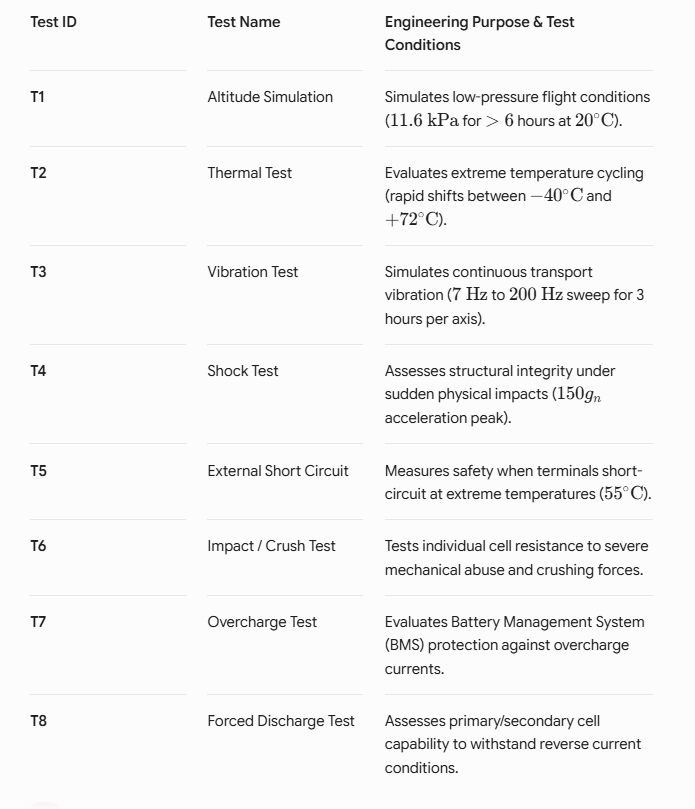
Required UN38.3 Test Sequence

UN38.3 testing requires battery cells and multi-cell packs to undergo a rigid series of environmental, mechanical, and electrical stress evaluations.

Target OEM Application Sectors

UN38.3 compliance is mandatory across all major battery-powered product categories:

  • Industrial Equipment & Robotics: Automated Guided Vehicles (AGVs), Autonomous Mobile Robots (AMRs), portable diagnostic equipment.
  • Medical Devices: Portable monitoring systems, mobile ventilators, surgical power tools.
  • UAV & Commercial Drones: Mapping equipment, inspection drones, defense systems.
  • IoT & Smart Infrastructure: Asset tracking devices, remote environmental monitors, smart utility meters.

Common Causes of UN38.3 Failure

  1. Subpar Cell Quality: Low-tier cells exhibit high internal resistance variations, leading to thermal instability under stress.
  2. Inadequate BMS Design: Weak protective circuitry fails to interrupt current during short-circuit (T5) or overcharge (T7) testing.
  3. Weak Mechanical Housing: Insufficient internal structural support leads to broken solder joints, disconnected nickel strips, or cracked outer enclosures during shock (T4) and vibration (T3) tests.
  4. Thermal Accumulation: Inadequate cell spacing traps heat, accelerating runaway during high-temperature short-circuit tests.

How Custom Battery Engineering Accelerates Compliance

Partnering with experienced custom battery engineering specialists mitigates certification risks and prevents redesign loops. Custom designs optimize performance through:

  • Integrated BMS Architectures: Custom-tuned firmware and hardware protections ensure instantaneous disconnects during overcharge and short-circuit conditions.
  • Advanced Thermal Barrier Engineering: Phase-change materials, thermal pads, and directional heat dissipation prevent cell-to-cell thermal propagation.
  • Ruggedized Structural Enclosures: Custom-molded housings and isolated cell holders absorb high-G impacts and continuous harmonic vibration.

Compliance Best Practices for OEMs

Do:

  • Select tier-1 cell manufacturers with per-certified base chemistry testing.
  • Integrate multi-tier BMS hardware protection logic.
  • Implement physical thermal barriers between high-energy density cells.
  • Work with experienced battery design partners early in the development cycle.
  • Maintain complete UN38.3 Test Summary documentation (per UN 38.3.5 requirements).

Avoid:

  • Using off-the-shelf, non-validated consumer-grade battery assemblies.
  • Postponing compliance design until late prototype stages.
  • Omitting structural vibration and shock resistance in internal pack geometry.

Frequently Asked Questions

1.Is UN38.3 certification mandatory globally?
Yes. International transport authorities including IATA, ICAO, IMO, and DOT mandate UN38.3 compliance for shipping lithium batteries by air, sea, rail, or road.

2.Does every custom battery configuration require its own UN38.3 test?
Yes. Any change to cell type, pack architecture, series-parallel configuration, enclosure design, or BMS protection scheme requires a new test sequence or official change evaluation.

3.How long does the UN38.3 certification process take?
Standard testing timelines typically range from 4 to 6 weeks, depending on laboratory availability, pre-test preparation, and battery cycle times for overcharge and thermal stability tests.